
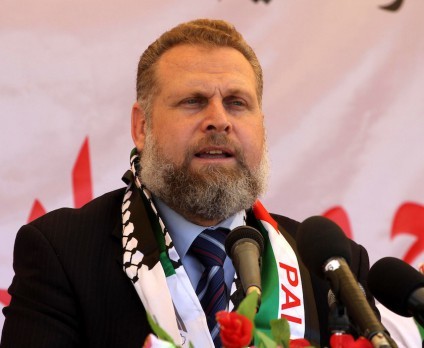
Osama Atiya Ahmed al-Muzaini
Osama (Usāma) al-Muzaini (أسامة عطية احمد المزيني), 57, was a scholar of psychology, a member of the politburo of the Islamic Resistance Movement, and a minister of education from 2011-2014. After he left government, he became an assistant professor of psychology at the Islamic University of Gaza, where he founded an academic center at “the important intersection of the goals of Islam and the goals of psychology.”
As a scholar, activist, and public official, al-Muzaini engaged concretely with the material and psychosocial impacts of Israel’s unrelenting assaults on Gazan society.
Born in 1966 in al-Shuja`iyya neighborhood east of Gaza City, al-Muzaini recounted how he came to meet Shaykh Ahmed Yassin, founder of the Islamic Complex (al-Mujamma al-Islami), a large network of kindergartens, health clinics, and sports clubs established in 1973. He would later marry one of Yassin’s daughters, Mariam.
Al-Muzaini majored in psychology at the Islamic University of Gaza (IUG), and was elected chair of the student council in 1987. At that point in the mid-1980s, student union elections were a four-cornered struggle between Fatah, Palestinian Islamic Jihad, the Popular Front for the Liberation of Palestine (PFLP), and the Muslim Brothers movement that al-Muzaini belonged to and later evolved into Hamas.
He pursued graduate work in psychology, earning an MA from IUG in 2001. In 2005, he received a PhD in a joint program between Ain Shams University in Cairo and al-Aqsa University in Gaza.
From 2006 to 2014, al-Muzaini played a prominent role in politics. He was the Palestinian point-person for the protracted negotiations to exchange Gilad Shalit, the Israeli soldier captured by several Palestinian factions in June 2006, with hundreds of Palestinian prisoners.
In 2011, he was appointed Minister of Education and Higher Education in the aftermath of Israel’s catastrophic 22-day assault on Gaza. Along with Israel’s blockade imposed in 2007, the 2009 assault worked like a vise on the education system. Schools and roads were destroyed. Prohibitions on the import of cement, paper, and glue meant that schools were rebuilt exceedingly slowly and lacked essential supplies. Overcrowding was the acute reality, with up to 50 students in some classrooms. The overwhelming majority of UNRWA and government-run schools operated on double shifts.
To secure funds for building schools, Minister al-Muzaini met with a stream of foreign donors and local notables. One notable event was a ribbon-cutting for six new libraries in schools, sponsored by the prominent female parliamentarian and scion of Gaza’s Shawwa family, Rawia al-Shawwa.
Al-Muzaini also capitalized on the regime changes sweeping the region in 2011, traveling to Tunisia to meet the postrevolutionary Education Minister and facilitate exchange opportunities for Gaza students, despite Israel’s blockade.
In 2014, al-Muzaini left government and began an appointment as Assistant Professor in the Psychology Department of the Faculty of Education at IUG. He supervised scores of Master’s theses on the psychosocial conditions of both relatively privileged and marginalized subgroups in Gaza, including university students, battered women, and female prisoners. His own research focused on one such marginalized cohort: women widowed by Israel’s 2008-2009 attack and the distinct kinds of suffering they experienced.
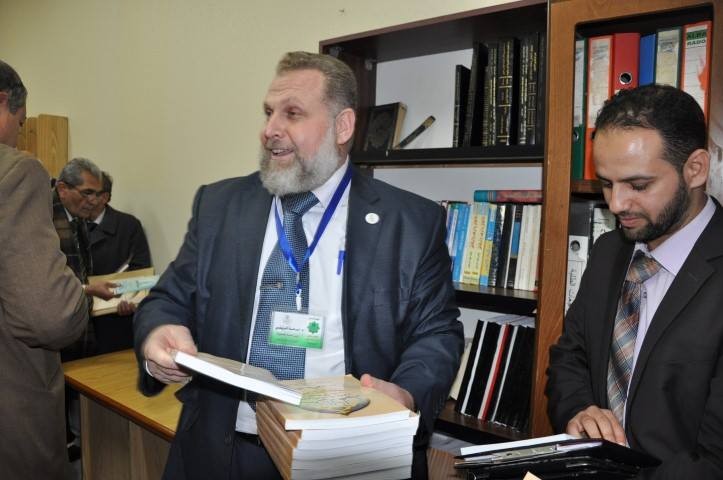
In 2016, he founded The Islamic Foundation of Psychology Center (Markaz al-Ta’sil al-Islami l-ilm al-Nafs), conceived in its mission statement as “ a step on the path to establishing an Islamic school of psychology and social sciences.”
On the evening of 16 October 2023, an Israeli airstrike killed al-Muzaini and his two sons in their home.
Photo credits: al-Maseera; X