
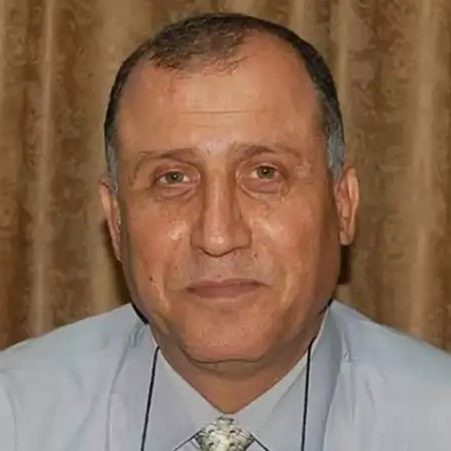
Fadil Khaled Hussein Abu Hein
Fadil Abu Hein (Faḍl Abū Hayn) (فضل خالد حسين أبو هين) was a professor, researcher and psychologist at al-Aqsa University for more than 20 years. He was a beloved teacher and a prolific scholar with a distinguished career as a psychologist-practitioner. He was an expert in treating trauma and the mental health effects of exposure to violent conflict and war, and he worked hard to de-stigmatize mental health treatment in Gaza.
Dr. Abu Hein grew up in Gaza City where he lived in al-Shujaʿiyya neighborhood. He earned both his master’s and doctorate degrees from the Department of Clinical Psychology at Ain Shams University, Cairo. When he returned to Palestine, he took up a teaching position in the Psychology Department at al-Aqsa University in Khan Yunis. For some years he also served as department head. He had a parallel career as psychotherapist and professional trainer-supervisor through work he conducted at the Center for Psychological Counseling and Human Development and as director of the Community Training Center for Crisis Management, both in Gaza. And he shared his expertise in multiple ways and with diverse audiences: he routinely attended academic conferences and professional meetings in Europe and elsewhere, and spoke on popular Palestinian talk shows to respond to questions about psychological challenges.
He had his own, personal experience with violence. In 2003, he was arrested by Israeli forces during a military incursion in al-Shuja`iyya that resulted in 13 Palestinians being killed, among them his three brothers. His family home was later razed to the ground by the Israeli military.
Fadil Abu Hein has numerous publications, most of which appear in al-Aqsa University’s Journal of the Humanities. His early publications, beginning with his 1985 master’s thesis, describe mental health symptoms of segments of the Palestinian population in Gaza. Later publications address scientific studies he undertook and their findings regarding the effects of specific forms of violence. For example, a 2001 article discusses the psychological effects on Palestinian children of house demolitions carried out by Israel; a 2006 article treats the psychological effects of captivity and torture and their impact on coping strategies of Gazans released from Israeli prisons. Another set of publications identifies a particular ‘episode’ in the long trajectory of conflict and violence – the al-Aqsa Intifada (2000-2005) – and considers psychological variables and effects. For example, two articles published in 2001 investigate the choice among Palestinian youth to participate in the Intifada and its relationship to their sense of self-esteem.
During and following the Israelis’ three-week military offensive from 27 December 2008 to 18 January 2009, Fadil Abu Hein and his colleagues interviewed 950 families, among them 2,180 children, across Gaza, and found that a majority of children displayed signs of trauma. Once a ceasefire took hold, teams from his center went into areas most affected by the onslaught to provide children with emergency counselling. Of this violent episode, Abu Hein insisted at that time — more than 15 years before the present, ongoing genocide — that it had inflicted more severe trauma than previous conflicts in Gaza because civilians did not have a “safe zone”. In an interview in 2022 he indicated that “[I]t is difficult to provide psychological treatment because Gaza lives in a changing reality…”
Fadil Abu Hein was killed by a sniper on 23 January 2024. He was in Khan Yunis when Israeli forces besieged the city. He was 66 years old.
Learning of his death, colleagues and students shared moving tributes, among them: “…My heart breaks for the life he has endured, the dignity he displayed and his unnecessary death…. a huge loss to the people of Gaza.”
Photo credit: Gigaza