
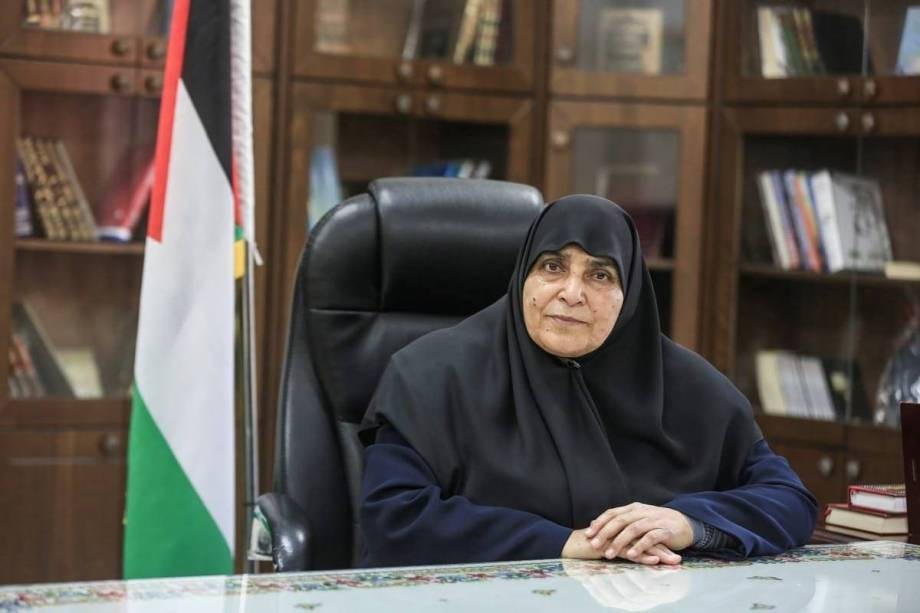
Jamila Abdallah Taha al-Shanti
Jamila al-Shanti (Jamīla al-Shanṭī) (جميلة عبد الله طه الشنطي) was a teacher, university lecturer, and one of the most prominent politicians in Gaza. She held posts as a parliamentarian, government minister, and the first and only woman member elected to the politburo of the Islamic Resistance Movement, Hamas.
Dr. al-Shanti was born in Jabalya Refugee Camp in 1955 or 1957 to a family from a village near Majdal. She was educated in UNRWA schools, then traveled to Cairo for university, where she earned a BA in English Language and Literature from Ain Shams University in 1980.
At Ain Shams Dr. al-Shanti joined the Society of Muslim Brothers (Jam`at al-Ikhwan al-Muslimun), finding it a congenial milieu for what she described as her conservative upbringing. After graduation, she moved to Saudi Arabia to teach English for 10 years to support her five younger siblings. Upon returning to Gaza in 1990, she joined the Faculty of Education at the Islamic University of Gaza as a lecturer, where she earned an MA in 1998 and a PhD in Education Management in 2013.
In 2006, Dr. al-Shanti came to prominence when she was one of six women elected to the Palestinian Legislative Council (PLC) on the Hamas slate. At number three, Dr. al-Shanti was the highest-placed woman; Hamas leader Ismail Haniyeh was first.
Journalist Paola Caridi observed that Dr. al-Shanti was among “the small platoon of women deputies who arrived in Parliament, allowing women to carve out for themselves a role that the more conservative sectors of Hamas would not have wanted.”
In a 2008 article in al-Bayan, Dr. al-Shanti described a de facto gender equality forged in the fire of Israeli occupation, which “has observed no sanctity for women, nor revered their motherhood, and so they confront the occupation forces head-on, trading fire with fire and blood with blood.”
Dr. al-Shanti was alluding to a protest by hundreds of Islamist women that she led in 2006, to free fighters besieged in a mosque during an Israeli attack on Bayt Hanun, a harrowing episode that she recalled in The Guardian.
A few days later, Israeli warplanes destroyed Dr. al-Shanti’s house, killing her sister-in-law Nahla, a widow raising eight children.
In 2013, Dr. al-Shanti was appointed Minister of Women’s Affairs in the Hamas administration. She focused on female unemployment and proportional representation of women in leadership positions. Reflecting on the experience, she said that being a minister brought her into contact with a far wider range of women in Gaza and taught her the rigors of administrative work.
In early 2021, Hamas conducted its regular internal elections among members in Gaza, the West Bank, and those incarcerated across 22 Israeli prisons. The results netted a nearly 30% leadership turnover, and Dr. al-Shanti became the first woman ever elected to the 19-member politburo.
Asked by an al-Jazeera anchor why it had taken Hamas so long to include women in its peak leadership council, Dr. al-Shanti said that Hamas leaders sought to protect female members from Israeli assassination. But after the 2014 Israeli assault on Gaza, “women were targeted regardless of where they were,” so there was no longer a credible rationale for shielding them.
On 18 October 2023, Dr. al-Shanti was killed in an Israeli airstrike on her home, becoming the fourth Hamas politburo member to be killed at that point.
The Palestinian Legislative Council paid tribute to Dr. al-Shanti, “who lived a life brimming with exertion and sacrifice to uplift the Palestinian cause. We will continue on her path and the path of all our righteous martyrs, until the occupation of our lands is defeated.”
Photo credit: Ali Jadallah/Anadolu Agency