
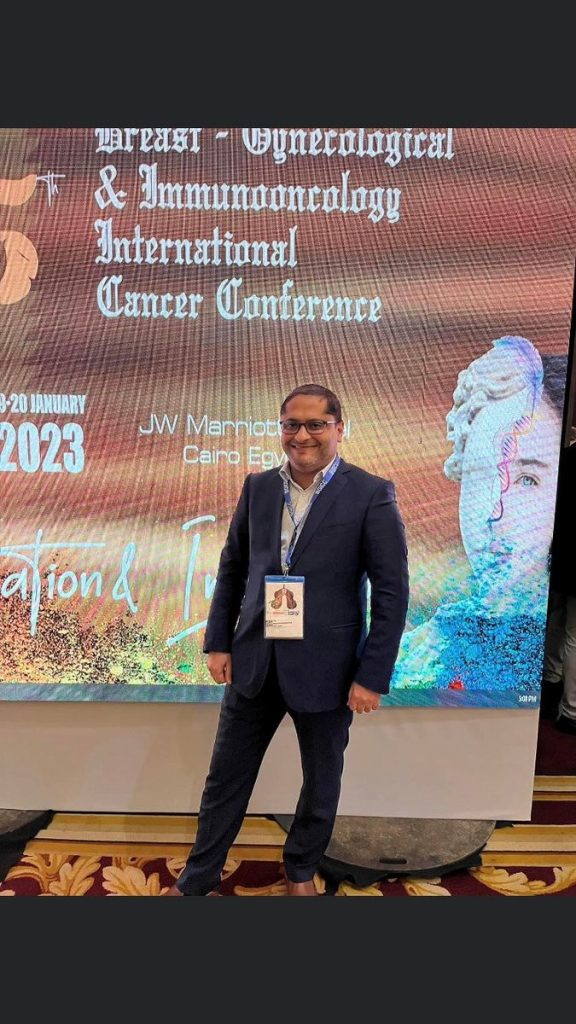
Mohammad Assa`ad
Mohammad (Muḥammad) Assa`ad (on some websites his last name is Dabbour) (محمد أسّعد) was both an academic and a highly-trained physician. He served as a lecturer in pathology and head of the Department of Pre-clinical medicine at the Faculty of Medicine of the Islamic University of Gaza. He was the first and perhaps the only oncological pathology specialist in Gaza. At the same time, Assa`ad practiced as consultant pathologist at the al-Shifa’ Hospital that was later ravaged during an all-out attack by the Israeli army in March 2024.
Assa`ad received his first medical degree from al-Azhar University in Gaza City in 2006. He completed his residency in anatomic pathology at the University of Jordan in Amman in 2013. He then pursued specialized training through a fellowship in oncologic pathology and hematopathology at the King Hussein Cancer Center (KHCC) in Amman, Jordan. He returned to Gaza in 2015, and while teaching and practicing, he received the certificates of both the Jordanian and Arab Board of Health Specializations (ABHS).
An energetic researcher, Assa`ad attended international conferences on pathology, including one in Cairo (2023) and another in Amman, Jordan (2018). And he organized the first conference in Gaza on the current state of cancer treatment in the Strip, which was to be followed by a second one, but his plans were derailed by Israeli fire.
Assa`ad was also a pioneering practitioner. He established the first laboratory in Gaza for analyzing biopsies, work that had to be done outside the country prior to his initiative. In June 2022, he returned to Amman for a one-month training program in flow cytometry at KHCC, with the aim of establishing and overseeing a laboratory for flow cytometry in Gaza. He had done clinical cancer research at the American University in Beirut with the Palestinian-British physician Ghassan Abu Sitta, who wrote a manual on medicine in war and survived an Israeli bombardment of Gaza’s Baptist Hospital. Later on, Assa’ad was awarded the 2023, two-year CREEW fellowship from the Global Health Institute and the Naef K. Basile Cancer Institute at the American University in Beirut, Lebanon.
This possibility, like others, was aborted when Israeli troops fired on Assa`ad’s car on 13 October 2023 while on his way south with his family and thousands of others, after an evacuation order by the invading army. Born 13 February 1982, he was only 41 years old when he was murdered. The bullets that killed him also ended the lives of both his father and his son `Ātif, a 16-year-old gifted athlete who dreamed of becoming an international soccer player. The last words Assa`ad posted to the “outside world,” were: “We are doing well, you too, God willing?”
Abdelghani Tbakhi, now a professor at McMaster University in Canada, had served as a professor and chair at KHCC during the time Dr. Assa`ad (whom he refers to as Dr. Dabbour) was a fellow there. In the Cancer Letter, based in Washington D.C., Dr. Tbakhi mourned the loss of Dr. Assa`ad, remembering him as an “extraordinary soul” and an “exceptionally kind and dedicated individual” whose “life was tragically cut short during his unwavering commitment to this vital mission of caring for cancer patients and advancing cancer practice in Gaza.”
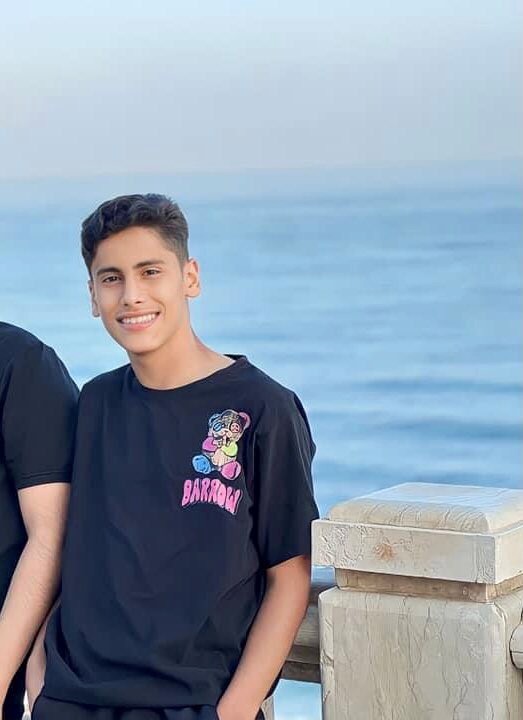
(Mohammad’s son, `Ātif)
Photo credits: X (for both photos)