
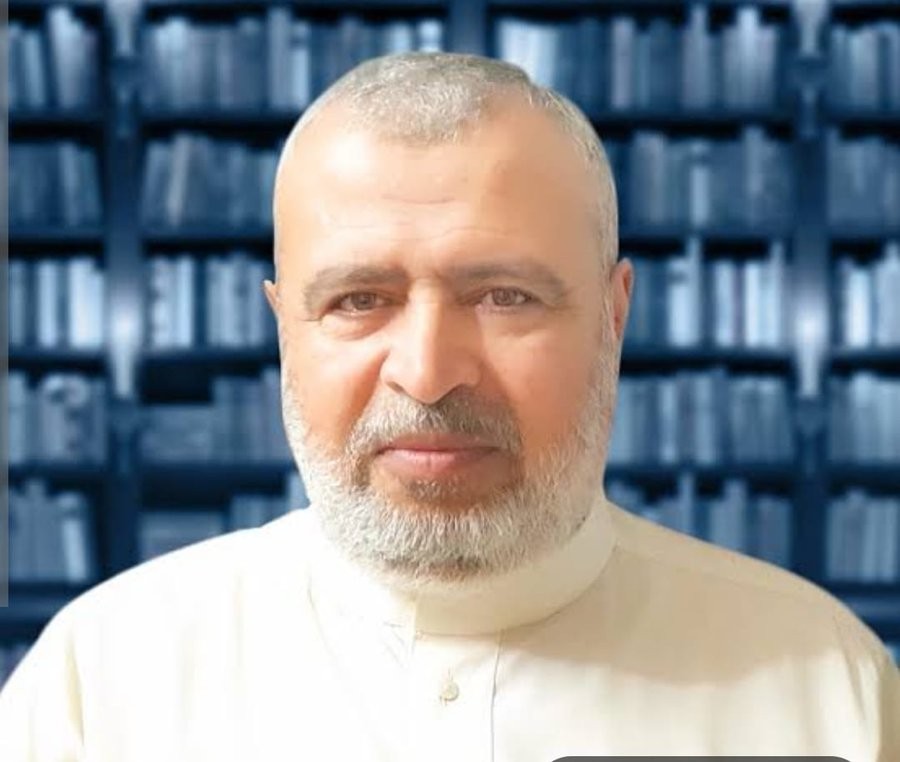
Waleed al-Amoudi
Waleed al-Amoudi (Walīd al-‘Āmūdī) (وليد العامودي), 65, was a scholar of the Qur’an as a text and a guide to life; a theology professor; the head of a federation of Gaza charities; the imam of al-Masjid al-Gharbi in al-Shatti Refugee Camp; and a past member of the politburo of the Islamic Resistance Movement, Hamas.
Dr. al-Amoudi was born in 1958 in al-Shatti Camp to a family expelled from Yafa (Jaffa) in 1948. In 1982, he received a bachelor’s degree in Fundamentals of Religion from Imam Mohammad Ibn Saud Islamic University in Riyadh, and six years later earned a master’s from Sharia College at the University of Jordan. His thesis is an exegesis (tafsir) of the Qur’an’s Surat Fatir, “to reveal the intersection of faith and science, and highlight the mind’s standing in the Islamic conception.”
He began working as a teacher at UNRWA schools, and in 1997 earned a PhD in Qur’anic Exegesis from the University of the Holy Qur’an and Islamic Sciences in Omdurman, Sudan. His dissertation argued for the superiority of the Qur’an’s methods of exposition of doctrine, compared to the methods of Muslim philosophers and speculative theologists (mutakallimun). It was later published as a book.
Also in 1997, Dr. al-Amoudi was appointed to the Department of Qur’anic Exegesis at the Islamic University of Gaza (IUG), and elected to the first politburo of the Islamic Resistance Movement. Later in the 2000s, he also became Dean of the Libraries at IUG. He taught courses on Qur’anic Studies, Exegesis, and Special Topics. Some of his course lectures are audio-taped.
His other published work consists of articles on Qur’anic studies, including analysis of specific suras and a paper on Ibn Taymiyya’s approach to revelation.
For over a decade, Dr. al-Amoudi chaired the Federation of Gaza Charities, catering to orphans, poor families, and building reconstruction. In 2013, the charity sector was hit by the dual impact of the Israeli blockade and the swift closing of the Rafah crossing by the new Egyptian military government, barring entry to solidarity delegations bringing food and Eid donations. “Gaza charities have not received any funds to buy Udhiya for distribution to the strip’s poor and needy, while the plans for clothing have also come to a halt,” he told a reporter at the time.
For over 20 years, Dr. al-Amoudi supervised scores of Master’s and PhD theses on an astonishing range of Qur’anic studies, such as the conception of friendship in the Qur’an; the meanings of abandonment (hajr); the connection between calligraphy and exegesis; and ways of confronting the siege in light of the Qur’an. The acknowledgments section of some theses express gratitude in terms that transcend the dutiful and formulaic. “He carried with me the burdens of research, and spared no effort in offering me moral and academic support. He is the best mentor,” wrote one. Another recounted, “He guided me step by step, taught me optimism and moving forward, graced me with his deep learning and his kind heart. His guidance will forever be a lantern lighting my future path.”
Dr. al-Amoudi was killed on 10 November 2023 in Gaza City in an Israeli air strike, along with his son-in-law, `Ali `Adnan Abu `Auda. One of his sons, Abdallah, a scholar of Hadith, had been killed days earlier on 5 November 2023.
Photo Credit: Gigaza